
'A Stern Warning to External Forces'

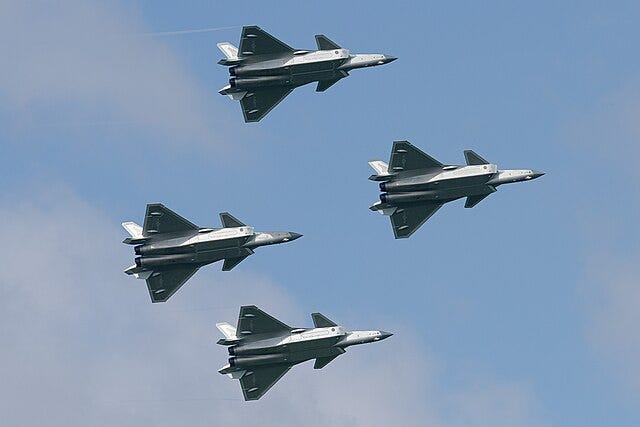
The announcement of USD 11 billion in new American weapons for Taiwan has been met with the largest Chinese military exercises ever conducted around the island.
Predictably, the question has followed: does this presage war—or is Beijing signalling displeasure while stopping short of conflict?
The answer matters enormously. And my assessment is that what we are witnessing is posture, not preparation for imminent war.
From pragmatism to personalisation
From 1978 through roughly 2012, the Chinese Communist Party governed with a largely pragmatic worldview. The leadership understood that genuine military parity with the United States in the Western Pacific lay far in the future. China’s priority was wealth creation, internal stability, and integration into a rapidly expanding liberal, multilateral global system.
As the world’s manufacturing hub, China benefited enormously from cooperation. Tolerating political differences with the West was a price worth paying for access to markets, technology, and capital.
This logic changed fundamentally with Xi Jinping’s ascent in 2012.
Rather than preserving the internal checks and balances designed to prevent excessive concentration of power, Xi dismantled them. Loyalty replaced competence. Pluralism gave way to conformity. China transitioned into a personalised autocracy, where strategic judgment increasingly reflected the worldview of one man.
Hard power as identity
Like Vladimir Putin, Xi has come to relish hard power. Military parades, inspections of weapons systems, appearances with veterans—these are not incidental. They are political theatre, signalling resolve and projecting strength both domestically and internationally.
Xi’s rupture with the West during and after COVID-19 reinforced this trajectory. Confrontation hardened. Nationalism intensified. Taiwan became not merely a policy issue, but a symbol of regime legitimacy.
Over the past five years, Chinese military activity around Taiwan has become increasingly aggressive. Air and naval manoeuvres near Japan and South Korea have increased. Each Western counter-move is then folded back into domestic propaganda, reinforcing the message that China is under siege and that war may be unavoidable.
The untested force problem
Yet beneath the spectacle lies an uncomfortable reality.
China has not fought a war since 1979.
Its modern weapons systems, command structures, logistics chains, and doctrine have not been tested in sustained combat. Exercises—even large and complex ones—can be scripted, manipulated, and politically filtered. They often tell leaders what they want to hear rather than what they need to know.
This matters profoundly. For Xi to authorise war—especially across the Taiwan Strait—he would have to base assumptions on fact rather than theory, on battlefield performance rather than simulations. History shows how often such assumptions fail.
Posture instead of war
A 2020 report by SAGE International argued that even under a more belligerent leadership, China did not seek war. That assessment remains persuasive today.
Xi’s primary objective appears to be the displacement of American power beyond the first island chain, not the destruction of Taiwan through a ruinous conflict. The vast military build-up serves intimidation first, war-fighting second.
Why destroy the very economic and social foundations of Chinese power when threats, feints, and sustained pressure might achieve more?
By exploiting Western openness, democratic scepticism, and fatigue with prolonged confrontation, Beijing may calculate that time is on its side. Public opinion in the United States and its allies may tire of constant tension over an issue felt viscerally in Beijing but only abstractly in Western capitals.
Rethinking the threat
If this reading is correct, then the China challenge by 2026 may not be one of imminent invasion, but of strategic endurance. The danger lies not in sudden war, but in a prolonged campaign of coercion, intimidation, and incremental advantage.
Understanding that distinction is essential—because responding to posturing as if it were war-fighting risks miscalculation, escalation, and exactly the conflict both sides claim to want to avoid.
China’s Use of Conventional Military Power: Interventions vs Exercises
1949–1979 vs 1980–2025
1949–1979: Wars, Border Clashes, and Direct Kinetic Action
Interventions / Clashes
1950–1953 – Korean War
China intervened with large conventional forces to prevent U.S./UN troops from reaching its border and to secure a communist buffer on the peninsula.1954–1955 – First Taiwan Strait Crisis
Artillery attacks and amphibious pressure against ROC-held offshore islands to deter U.S. alliance consolidation and assert sovereignty claims.1958 – Second Taiwan Strait Crisis
Sustained shelling of Kinmen and Matsu to undermine Taiwan’s control of offshore islands and test U.S. extended deterrence.1962 – Sino-Indian War
A short, decisive conventional campaign designed to enforce territorial claims and punish India’s forward defence posture.1969 – Sino-Soviet Border Clashes
Armed engagements along the Ussuri River signalled resistance to Soviet pressure and the willingness to fight a nuclear-armed rival.1974 – Paracel Islands Battle
Naval action against South Vietnam to seize and consolidate control of disputed islands in the South China Sea.1979 – Sino-Vietnamese War
A punitive invasion intended to “teach Vietnam a lesson” and reassert China’s regional primacy after Hanoi’s alignment with Moscow.
Exercises / Deployments
1950s–1970s – Limited formal exercises
PLA training focused on mass mobilisation, infantry warfare, and political reliability rather than signalling or joint operations.1958 – Taiwan Strait live-fire drills
Large-scale coastal artillery and force movements integrated directly into crisis escalation with Taiwan.1960s–1970s – Border manoeuvres
Troop movements along the Indian and Soviet borders were designed to support limited wars rather than deter through signalling alone.
1980–2025: Coercion Without War, Exercises as Strategy
Interventions / Clashes
1988 – Johnson South Reef (Spratly Islands)
Naval clash with Vietnam to establish physical control over contested maritime features.1990s–present – South China Sea maritime confrontations
Incremental use of naval and maritime forces to enforce sovereignty claims while avoiding open warfare.2020 – Sino-Indian border clashes (Galwan period)
Conventional force confrontation to enforce disputed borders while deliberately controlling escalation.
Exercises / Deployments
1995–1996 – Taiwan Strait missile tests and exercises
Strategic coercion aimed at deterring Taiwanese independence and warning the United States against military intervention.2009 – “Stride / Kuayue” exercises
Cross-theatre manoeuvres testing PLA mobility, logistics, and early joint-operations capabilities.1990s–present – UN peacekeeping deployments
Use of overseas deployments to build expeditionary experience, international legitimacy, and operational confidence.2008–present – Gulf of Aden anti-piracy missions
China’s first sustained far-seas naval presence, normalising long-range deployments and global maritime operations.2012–present – China–Russia “Joint Sea” naval exercises
Regular combined drills signalling strategic alignment and opposition to U.S. maritime dominance.2018 – Participation in Russia’s Vostok exercises
PLA’s first involvement in a major foreign strategic exercise markeda shift toward great-power military cooperation.
2022 – Taiwan encirclement exercises (post-Pelosi visit)
Multi-domain rehearsals for blockade, strike, and isolation scenarios around Taiwan.2023 – “Joint Sword” exercises
Explicit rehearsals of joint firepower, maritime denial, and political intimidation of Taipei.2024 – “Joint Sword-2024A”
Expanded joint drills refining command integration, escalation control, and tempo sustainability.2025 – Large-scale Taiwan pressure drills
Routine, near-continuous encirclement-style exercises signalling readiness while remaining below the threshold of war.
Key Analytical Insight
1949–1979:
China relied on short, violent wars and direct conventional clashes to resolve disputes and enforce red lines.
1980–2025:
China shifted toward persistent coercion without war, using exercises, deployments, and controlled clashes as instruments of political warfare—turning military activity into a permanent condition, not an exceptional event.