
Admiration and Ambivalence
Decoding the Trump–Putin Dynamic in an Era of Geopolitical Flux

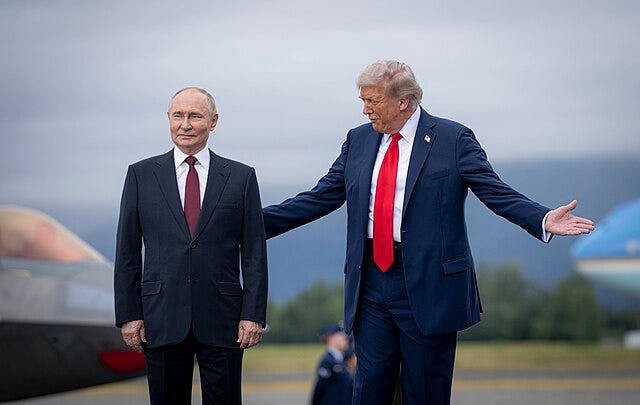
Putin: Authoritarianism and Strategic Assertiveness
Vladimir Putin’s political identity is rooted in his tenure with the KGB and his longstanding view that the West — particularly NATO — poses a fundamental threat to Russia’s security. This worldview has driven both domestic repression and foreign adventurism. Putin has consolidated power internally by neutralising political rivals, controlling the media, and co-opting state institutions. Externally, he has pursued territorial expansion and influence operations that directly challenge Western interests.
Trump: Admiration for Strongmen?
Observers have noted that Trump appears drawn to leaders who project strength and defy conventional constraints—a phenomenon political scientists refer to as “strongmen.” This pattern predates his current presidency and includes his praise for figures like Turkey’s Erdoğan and Hungary’s Orbán. Analysts interpret this as an affinity for power that is visible, personal, and unfiltered by bureaucratic checks and balances.
This affinity is not merely a diplomatic preference; it reflects Trump’s political psychology and leadership style. Critics often describe Trump as resistant to criticism and receptive to flattery — traits that make authoritarian leaders like Putin particularly adept at playing to his ego. Putin’s past compliments and diplomatic gestures can serve as psychological reinforcement, regardless of Russia’s actual strategic intentions.
When Affinity Meets Geopolitics
However, relations between Trump and Putin have not been straightforward. At key moments — from peace negotiations over Ukraine to sanctions and strategic competition — the two leaders have pursued divergent objectives. Russia’s rejection of international peacekeeping proposals and its vocal opposition to Western military presence in Ukraine underscore fundamental geopolitical differences.
Moreover, recent U.S. actions—such as sanctions legislation supported by members of both parties—reflect a broader American pushback against Russian aggression, even under Trump’s leadership.
A Dynamic, Evolving Relationship
The Trump–Putin dynamic illustrates how personal affinity and geopolitical interests can coexist—sometimes uneasily—in international relations. As global power balances shift, so too does the calculus of leaders on both sides. If Putin’s strategic leverage erodes, the dynamic could shift from mutual respect to competitive distance.
With the end of Putin’s influence in Syria (under former leader, Bashar al-Assad), in Venezuela under Nicolás Maduro, and the very real prospect of further setbacks in Iran under Ali Khamenei, Russia’s overseas power projection is weakening. Trump may quickly come to realise that Putin’s reputation as an unassailable strongman is no longer what it once was.
Conclusion: Strength, Strategy, and Uncertainty
What unites and divides Trump and Putin is not ideology but power — how it is wielded and perceived. For Trump, strength remains the ultimate currency. For Putin, survival and strategic advantage define his approach. In the interplay of these motivations, U.S. policy toward Russia — and particularly toward Ukraine — will continue to be shaped by both personal and structural forces.