
After Tehran Falls:
Why Even a Decisive War with Iran Wouldn’t Automatically Mean $150 Oil

When war breaks out in the Middle East, the reflex is Pavlovian.
Oil to $150.
Global recession.
Energy shock.
But history — and markets — are less sentimental than headlines.
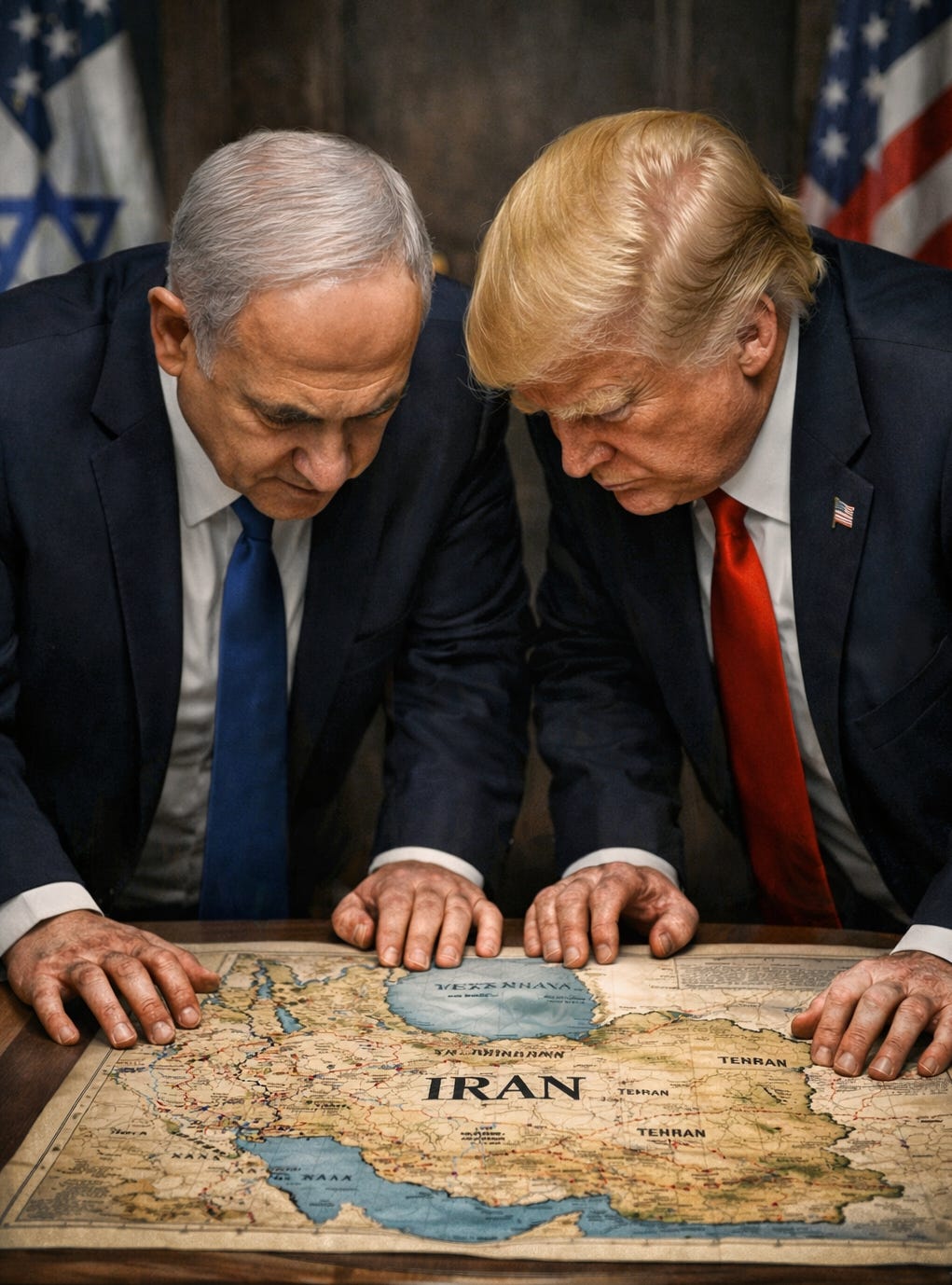
Let’s assume the most dramatic version of events: the United States and Israel launch a coordinated campaign against Iran. The kinetic phase lasts no more than fifteen to twenty days. The Islamic Republic collapses under the combined weight of external airpower and internal fracture. Tehran falls. A power vacuum follows. Civil conflict simmers for months.
It sounds like the script for a generational oil crisis.
It probably isn’t.
War Is Not the Same as Disruption
The oil market does not price morality, ideology, or regime type.
It prices flow.
In 1973, oil prices quadrupled not because war occurred — but because oil was deliberately weaponised and supply was withheld.
In 1990, Saddam Hussein’s invasion of Kuwait triggered a spike because actual barrels disappeared from the market.
In 2003, the U.S. invasion of Iraq — despite enormous geopolitical controversy — did not produce a structural oil shock because supply disruption proved manageable.
The lesson is simple: conflict alone does not determine price. Sustained supply interruption does.
Under a short, decisive campaign against Iran — especially one in which Arab Gulf states do not join offensively and the Strait of Hormuz remains open — oil would spike. But it would not spiral uncontrollably.
The Spike: Fear Moves First
Before the first strike, Brent would climb into the high $70s or low $80s as funds hedge and volatility premiums inflate.
When strikes begin, prices likely surge into the $80–$90 band.
This is the “headline spike” — the emotional phase of markets.
But emotion has a half-life.
If tankers continue to transit Hormuz and Gulf exporters keep loading cargoes, markets begin to compress the risk premium. War becomes noise; flow becomes signal.
We saw this dynamic repeatedly in the 2019 tanker crisis, in the 2020 Soleimani episode, and even in the 2025 Israel–Iran exchange. Spikes occurred. Structural shortages did not.
Then, Tehran Falls
This is where analysts often leap to the conclusion of catastrophe.
A regime collapse in Iran would certainly inject uncertainty into global energy markets. Factional fighting near production fields, confusion over export authority, sabotage risk — these are real concerns.
But uncertainty is not the same as collapse.
If oil infrastructure remains largely intact — and if export terminals continue operating — Brent likely trades elevated but bounded: perhaps $80–$100 for several months.
That is disruption pricing, not systemic shock.
To reach $150 oil, you need something more severe:
A credible, sustained disruption of the Strait of Hormuz
Multi-producer Gulf infrastructure attacks
Or a deliberate, coordinated attempt to weaponise exports
Absent that, markets adapt.
The Strait of Hormuz: The Real Red Line
The true lever is not Tehran. It is Hormuz.
Roughly one-fifth of the oil traded globally passes through that narrow waterway. It is the psychological and logistical fulcrum of the global energy system.
But here is the uncomfortable reality for Tehran: closing or even credibly threatening Hormuz is an act that harms not only the United States and Israel — but China, India, Japan, South Korea, and Europe.
Weaponising Hormuz is a decision that risks unifying the world’s major energy consumers against you.
That is why it is threatened frequently and used rarely.
And without Hormuz becoming materially disrupted, oil prices struggle to sustain crisis-level pricing.
Civil War Is Not an Embargo
There is another misconception: that internal chaos equals immediate production collapse.
History does not fully support this.
Libya’s 2011 civil war disrupted output — but global markets rebalanced within months. Iraq’s post-2003 instability did not permanently remove it from global supply. Even Russia’s invasion of Ukraine did not erase Russian barrels from the market; they rerouted.
Energy markets are ruthless and adaptive.
If Iran fragments politically, oil will become a source of revenue for whichever faction can control export infrastructure. Incentives to keep production flowing are powerful.
Markets understand that.
The Likely Path
Under a short war + regime collapse scenario, the most plausible trajectory looks like this:
A sharp spike to $85–$90
Partial retracement as flows continue
Elevated but bounded pricing in the $80–$100 range during months of instability
Only if Hormuz becomes a genuine choke point does Brent plausibly move into the $110–$130 bracket — and even then, history suggests spikes are often temporary unless disruption is sustained.
The age of instant $150 oil requires conditions more extreme than mere regime change.
The Strategic Reality
Energy markets today are not the brittle systems of 1973. They are diversified, financialised, and globally interconnected.
Spare capacity exists. Strategic reserves exist. Financial hedging dampens shocks.
War still moves prices.
But it is the movement of tankers — not the movement of armies — that ultimately determines where oil settles.
If Tehran falls within weeks rather than months, the geopolitical earthquake would be enormous.
The oil shock? Dramatic, yes.
Permanent, probably not.