
Australia’s Defence Illusion:
Two Real Paths Forward


Australia’s latest defence thinking is built on a dangerous assumption: that we still have time.
Time to build; time to adjust, and time to rely on a system that is visibly weakening.
But what if we don’t?
The reality—laid bare in recent analysis of the 2026 National Defence Strategy—is that Australia is operating inside a narrowing window. The old strategic model is eroding, yet the new one is being built too slowly to matter when it counts.
For decades, Australia solved its security problem elegantly: outsource strategic defence to a reliable hegemon, build a small professional force, and contribute where needed. It worked because the international system was stable.
That system is no longer stable.
We now face a harsher reality: a mid-sized country, with a small population, a shallow industrial base, and vast maritime exposure, sitting at the edge of the world’s most contested region—without the ability to independently generate or sustain decisive hard power.
So the question is no longer abstract.
What does a country like Australia actually do when the strategic environment turns against it?
There are only two serious answers.
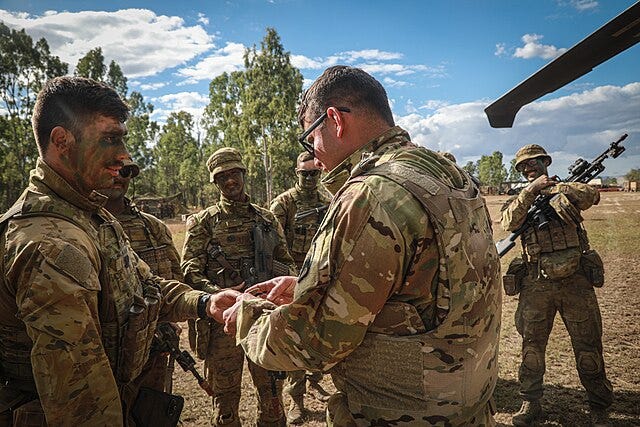
Option A: Fix the Volunteer Force — Properly
If Australia wants to avoid more radical measures, then the full-volunteer model must be transformed—not tweaked, not rebranded, but rebuilt.
Because the current model is too small, too brittle, and too slow to scale.
The answer is not just more ships, more missiles, or more advanced platforms. Without people—trained, retained, and available in sufficient numbers—those capabilities are hollow.
What Australia needs is a three-layer force structure:
A larger, more lethal full-time ADF as the ready core
A serious operational reserve, not a symbolic one
A national support base of skilled personnel across logistics, infrastructure, cyber, health, and sustainment
This is about building depth, not just capability.
The real problem: people
Recruitment and retention are not administrative issues. They are strategic vulnerabilities.
If Australia cannot attract and keep personnel, then every acquisition program becomes a liability.
So what changes?
Recruitment must become faster, simpler, and targeted—especially for technical skills. Mid-career entry must be normalised. Reserve entry must be streamlined and genuinely flexible.
Retention, however, is the real centre of gravity.
Housing, family stability, predictable career paths, and flexible service options are not perks—they are strategic necessities. Losing trained people is the fastest way to hollow out force structure.
The Reserve must be reimagined
Australia’s Reserve forces need to move from “part-time adjunct” to strategic backbone.
They should perform three roles:
Augmentation of active units
Reinforcement in crisis or conflict
Homeland defence and resilience
That means engineers, logistics units, port operators, cyber specialists, medical support, drone operators, infrastructure protection—not just light infantry.
The uncomfortable truth: this costs money
There is no serious version of this model that does not require increased spending.
Not marginal increases. Structural ones.
Australia must advance defence spending to 3% of GDP as soon as possible—not just for platforms, but for:
personnel,
munitions,
fuel reserves,
logistics,
training,
sustainment.
Because a warfighting system without people and sustainment is not deterrence. It’s theatre. And the 2026 National Defence Strategy, for all its high-sounding words, is just that, theatre, for one political party to play it ‘hard’ on defence rhetoric over the other.
The strength—and the risk
This model is politically feasible. It aligns with Australian values. And, importantly, it should be politically sellable while building a professional force.
But it has a weakness:
It may not scale fast enough.
And that matters, because the global strategic friction is accelerating.
Option B: National Service — Strategic Depth at Scale
If the environment deteriorates faster than expected—and there are strong indicators it might—then the volunteer model alone may not be enough.
At that point, Australia faces a harder choice:
Reintroduce national service.
Not as a throwback to the 1950s but as a modern system designed for a modern threat environment.
This is not about mass infantry
A contemporary national service model would not simply produce soldiers. It would produce national capability.
Participants would be streamed into:
military roles,
cyber and AI support,
logistics and transport,
infrastructure protection,
medical services,
emergency response and civil defence.
This creates something Australia currently lacks:
A trained national reserve that can be mobilised at scale.
A four-layer national defence structure
Under this model, Australia builds:
A full-time professional ADF
An active, trained Reserve
A mobilisation pool of former regular and reserve military personnel
A civil resilience layer capable of sustaining the nation under stress
This is not just about fighting wars. It is about surviving them.
Why this may become necessary
The uncomfortable reality is this:
Alliance reliability is becoming conditional
Crisis warning times are collapsing
Procurement timelines may prove irrelevant
Technological disruption may outpace acquisition cycles
If that happens, Australia will need something it does not currently possess:
Mass.
Not just equipment—but trained people.
The strengths—and the cost
National service delivers:
scale,
resilience,
mobilisation capacity,
a broader national understanding of defence.
But it comes at a price:
political resistance,
social disruption,
significant cost,
the need for serious institutional reform.
It only works if done properly. A token system would fail.
The Real Choice
This is not a theoretical debate.
It is a question of timing.
If Australia acts early, invests seriously, and reforms its volunteer force, Option A can work.
If it delays—and the environment worsens faster than expected—then Option B becomes unavoidable.
My View
Australia should pursue the volunteer solution immediately—at scale, with urgency, and with real funding behind it.
But it should also do something else, quietly and deliberately:
Prepare for national service.
Build the legal frameworks.
Design the training pipelines.
Map the industrial and civil integration.
Not because it is politically easy.
But it may become strategically necessary.
Final Thought
For decades, Australia’s defence model was built on a simple premise:
That someone else would provide time.
Time to prepare. Time to build. Time to respond.
That premise is now looking decidedly quaint and irrelevant.
And if time disappears, the only thing that replaces it is preparedness.
Australia must decide—now—how it intends to build it.
Compulsory basic military training never did me any harm. Looking back, the discipline was beneficial as was the reinforcing of the notion of community strength through collaboration and trust.
How would society today 'cope' with compulsory military training? That is a question I find challenging to contemplate!