
Australia’s Defence Spending Problem
More Money, Same Old Risks?

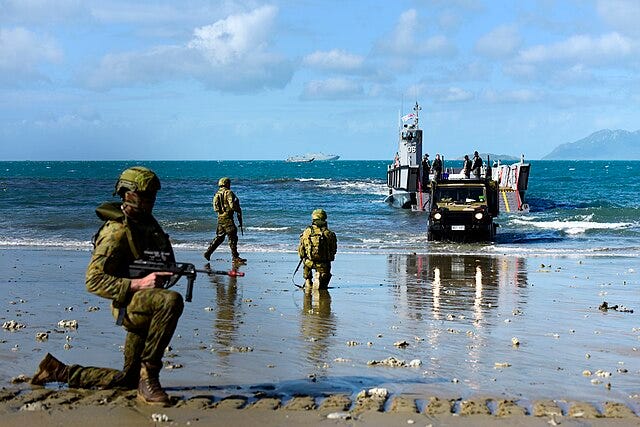
Australia’s strategic outlook has hardened dramatically over the past few years. The language coming out of Canberra is now unambiguous: the Indo-Pacific is becoming more contested, warning times are shrinking, and the risk of conflict—while still unlikely—is no longer remote.
In response, the government’s defence strategy points toward increased spending, potentially rising toward 2.5–3% of GDP over time. On the surface, this suggests a country waking up to a deteriorating security environment.
But the reality is more complicated.
The Illusion of Urgency
The defining tension in Australia’s current approach is this: the strategy speaks in the language of urgency, but the spending profile does not.
Yes, defence funding is increasing. But it is doing so gradually, over years and decades—not at the pace typically associated with rapidly deteriorating strategic conditions.
This creates a mismatch. If warning times are indeed shrinking, then a slow ramp-up in spending risks delivering capability too late to shape the environment it is meant to deter.
A Shift in What We Buy
Where the strategy is more convincing is in how money is being allocated.
Australia is moving away from a broad, general-purpose force toward a much more focused model built around a “strategy of denial.” The aim is not to project power globally, but to make it prohibitively difficult for an adversary to operate in Australia’s immediate region.
This has clear implications for spending priorities.
Investment is increasingly concentrated in:
Long-range strike capabilities
Submarines, particularly under the AUKUS framework
Missile systems and stockpiles
Northern Australian infrastructure and logistics
At the same time, legacy capabilities—particularly in the land domain—are being scaled back or rethought.
This is, in many ways, a necessary correction. For decades, Australia optimised its force structure for expeditionary operations alongside allies. The new strategy reorients the force toward the defence of Australia and its near region.
The Capital-Heavy Decade Ahead
The problem is that this new approach is extraordinarily expensive—and heavily backloaded.
The AUKUS submarine program alone represents the largest defence investment in Australian history, with costs running into the hundreds of billions over its lifetime. Add to this the need for missile production, infrastructure upgrades, and advanced technologies, and it becomes clear that Australia is entering a prolonged period of capital-intensive defence spending.
These are not quick wins. They are long-term bets.
And that raises a critical question: what happens in the interim?
The Capability Gap Problem
Australia is effectively wagering that it can manage rising strategic risk while waiting for future capabilities to come online.
This is a dangerous assumption.
Submarines will take decades. Infrastructure takes years. Even missile stockpiles require time to build at scale. In the meantime, the strategic environment continues to evolve.
The result is a potential “capability gap”—a period in which Australia’s existing forces may be insufficient for emerging challenges, while its future force remains incomplete.
The Procurement Reality
Even if the funding is there, there is another constraint: delivery.
Australia’s defence procurement system has a well-documented history of delays, cost overruns, and underperformance. This is not unique to Australia, but it is particularly acute given the scale and complexity of current projects.
In this context, more money does not automatically translate into more capability.
In fact, without reform, increased funding can simply lead to larger, more expensive delays.
Sovereignty vs Dependence
Another tension lies in the push for sovereign capability.
The strategy emphasises the need to build a domestic defence industry, reduce reliance on global supply chains, and increase national resilience. These are sensible goals, particularly in an era of geopolitical fragmentation.
But they come at a cost.
Producing defence equipment domestically is often more expensive than importing it. It also takes time to build the necessary industrial base. In the short term, this can slow capability delivery even as it strengthens long-term resilience.
At the same time, Australia remains deeply embedded in alliance structures—particularly with the United States. Programs like AUKUS reinforce interoperability, but also highlight the limits of true independence.
The Real Test: Execution
Ultimately, the success of Australia’s defence strategy will not be determined by how much it spends, but by how effectively it converts spending into capability.
This is where the greatest uncertainty lies.
The strategy is conceptually sound. The shift toward denial, the focus on the Indo-Pacific, and the recognition of a more dangerous world are all well-founded.
But strategy without execution is aspiration.
Australia is now entering a period where:
Spending will increase
Expectations will rise
Strategic risks will intensify
If procurement remains slow, if projects continue to slip, and if capability arrives too late, then the current approach risks becoming a case study in misaligned ambition.
Conclusion
Australia is not standing still. It is investing more, thinking more clearly about its strategic environment, and making difficult choices about its future force.
But it is also taking significant risks.
The central gamble is that a gradual increase in spending, combined with long-term investments, will be enough to navigate a rapidly changing security environment.
That may prove correct.
But if it does not, the issue will not be a lack of resources.
It will be a failure to turn those resources into a timely, usable capability.
And in strategy, timing is everything.
That first comment about turning away should have said "turning further away" .
What is the basis for the claim that the instability is increasing? My observation is that Australia is turning away from the region towards what once was, a stable USA and a strong imperial parent in the UK. Surely we are ignoring the realities of a Trumpist chaos, another looming US military defeat, a very likely chaotic and isolationist political period in post-Trump America, and a UK closely following a similar path. Who can rely on Submarines under AUKUS every being delivered in that environment?
Isn't our answer to build ever stronger ties within the Asia Pacific, to forge Asia / Pacific/ ANZ ties, to build on our connections with India, Pakistan, the ASEAN nations and develop a regional presentation to the world. India is a rising superpower. It has a massive economy. It has long-term relationships with China and Russia. We are a major supplier to China.
Surely we need to focus on our neighbourhood, to inoffensively reduce our UK / USA focus, remove foreign bases and live within our region, developing regional defence capabilities, manufacture defence apparatus for, and purchase from our neighbours.
BRICS and the other developing components of a new post-US / UK / Europe will replace much of what Trump has destroyed. Why is Australia lingering in a world that's going ..... going ..... gone?