
What Would Machiavelli Think?

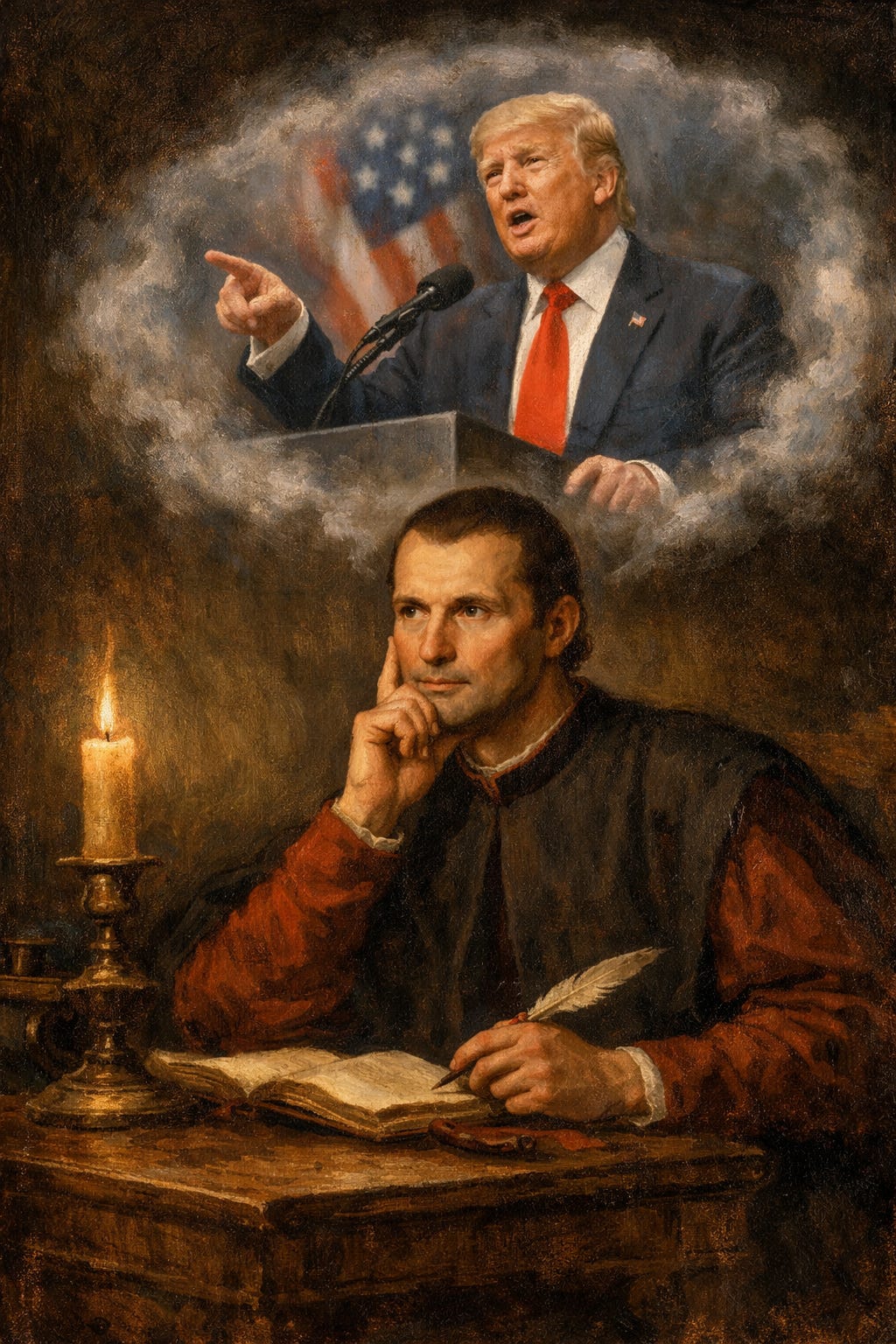
To Donald Trump’s supporters, he is not merely a politician but a strategist — even a visionary. He has thrown his weight around, frightened the weak, and jolted Europe out of its military slumber. The chaos is intentional. The abrasiveness deliberate. A cunning plan to make the West strong again.
In this worldview, nothing Trump says or does is too offensive, too irrational, or too out of bounds. Everything is instrumental. Everything is a means to an end. What critics call recklessness, supporters see as cold logic — necessary, deeply rational, even virtuous.
To Trump’s critics, however, a different picture emerges. Trump appears less like a strategist and more like a man in decline — a narcissist seeking validation. He courts admiration from strongmen he envies and demands fear from those he loathes: American liberals, Europe, democratic institutions, and the cultural forces he labels “woke.”
But perhaps the most useful lens through which to examine Trump is neither partisan nor psychological.
It is philosophical.
What would Niccolò Machiavelli think?
Machiavelli — the Renaissance master of political realism — is best known for the line: “It is better to be feared than loved, if one cannot be both.” This phrase has been weaponised for centuries by those who mistake cruelty for strength.
Yet Machiavelli’s argument was far more subtle.
Fear, he argued, must be controlled. Hatred is fatal. A prince who governs only for a faction, who alienates large portions of his own people, undermines the stability of the state itself.
Trump does not rule for America as a whole. He rules for his MAGA supporters. Large parts of the country — blue states, cities, institutions — are excluded from his conception of “the people.” They are not governed; they are opposed.
This matters.
“America First” is not a strategy for alliance-building. It does not strengthen partnerships rooted in shared values. It dismisses Europe as weak and decadent — too committed to pluralism, human rights, gender equality, and liberal democracy.
Nor is “America First” about advancing justice or opportunity abroad. It offers no vision for global leadership grounded in ideals. Instead, it redefines allies as those who rule through strength, fear, and transactional loyalty.
In this framework, America’s natural partners become not its historic democratic allies, but autocracies: Russia, China, North Korea — regimes that neither seek nor require the consent of their people.
Trump appears drawn to this world. A world where legitimacy is replaced by dominance. Where unpredictability is mistaken for leverage. Where money is the ultimate currency and values are an inconvenience.
Machiavelli would recognise the appeal of power unconstrained. But he would also recognise its fragility.
A state that abandons trust, shared norms, and legitimacy does not become stronger — it becomes isolated. Fear can coerce, but it cannot bind. Transactions can buy compliance, but not loyalty.
And so the question remains unresolved.
As the Trumpian experiment unfolds — in all its promised golden splendour — we must keep asking:
Would Machiavelli see this as realism done right?
Or as a prince confusing fear with strength, and dominance with durability?