
Winning by Not Losing

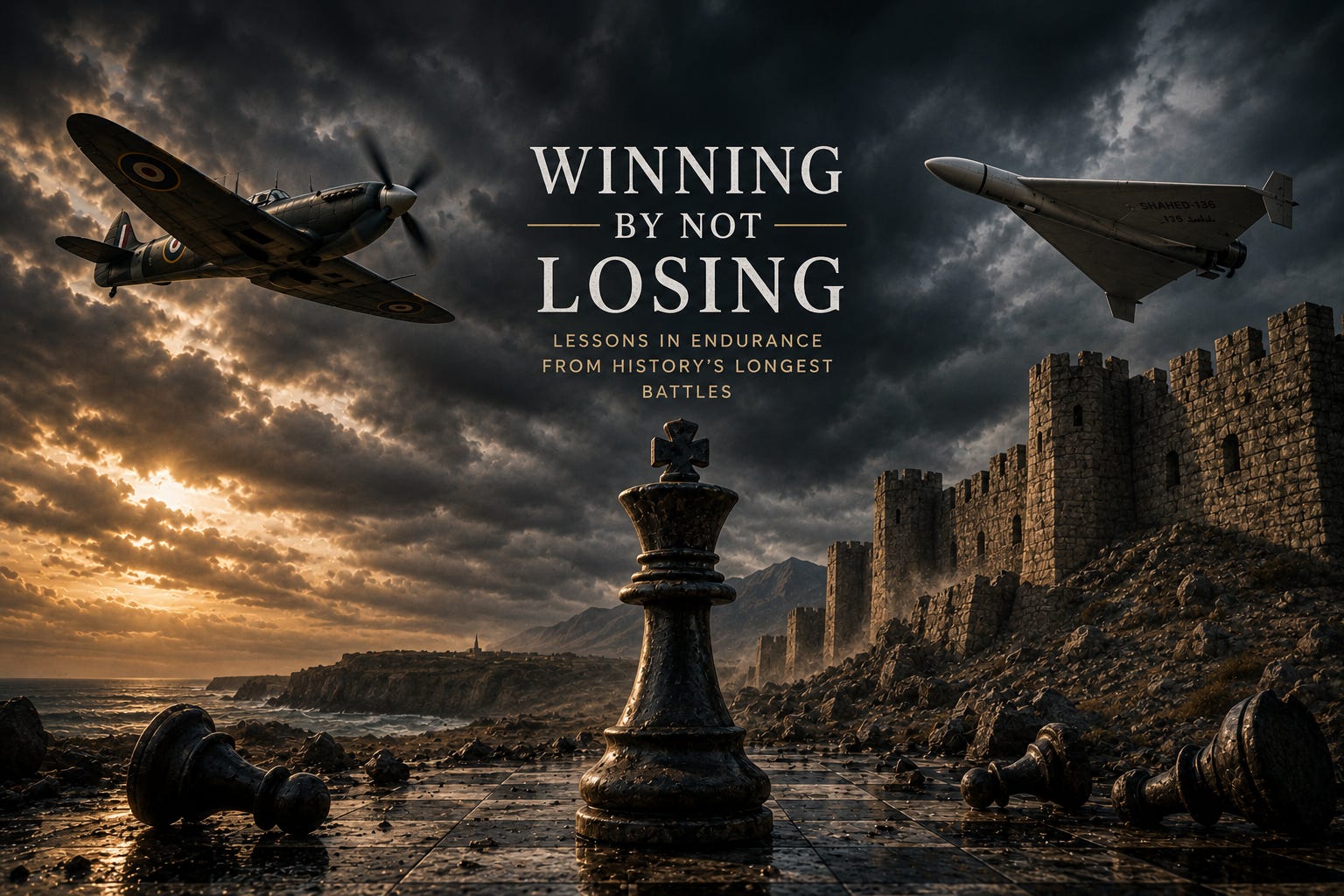
Modern audiences have inherited a deeply distorted understanding of warfare.
For many, war is viewed through a cinematic lens. The narrative is familiar. The protagonists are morally justified. Their opponents are corrupt, incompetent, or evil. Through superior skill, courage, technology, or determination, the heroes achieve decisive victory. The conflict ends. Justice prevails.
It is an attractive story.
It is also one that bears only a passing resemblance to how wars are usually won.
Real warfare is rarely defined via decisive moments. More often, it is characterised by endurance, adaptation, and survival. The side that ultimately prevails is frequently not the one that wins the most battles, but the one that refuses to collapse.
History provides numerous examples.
In 1940, Britain did not defeat Germany. At least not in the conventional sense. The British Army had been expelled from continental Europe. Much of its equipment had been abandoned at Dunkirk. Germany dominated the continent.
Yet Britain survived.
That survival became the basis for eventual victory.
The Winter War offers another example. Finland did not defeat the Soviet Union. The Red Army ultimately forced Helsinki to make territorial concessions. Yet Finland preserved its independence and sovereignty against overwhelming odds. What appeared on paper as a Soviet victory was widely regarded as a Finnish strategic success.
Vietnam offers perhaps the clearest example of all. The United States won most of the major military engagements. It inflicted enormous losses upon North Vietnamese forces. Yet North Vietnam understood a basic truth: it did not need to defeat the United States militarily. It simply needed to endure longer than American political support for the war.
The same principle would later apply in Afghanistan, first against the Soviet Union and later against the United States and NATO.
The lesson is clear.
Victory is not always about imposing one’s will upon the enemy.
Sometimes it is about preventing the enemy from imposing its will upon you.
This distinction is important when examining contemporary conflicts, including the ongoing confrontation involving Iran.
Public discussion often focuses on whether Iran can defeat Israel or the United States. Such framing assumes that Tehran’s objectives mirror those of a conventional military power seeking battlefield dominance.
They do not.
Iran’s strategic objectives are likely far more modest and therefore far more achievable.
The Iranian leadership does not necessarily need to become stronger than its adversaries. It does not need to occupy territory. It does not need to destroy opposing military forces.
Instead, it needs to survive.
It needs to preserve the regime’s continuity.
It ought to maintain enough military capability to thwart future attacks.
It needs to avoid internal collapse.
Most importantly, it needs to convince its opponents that the costs of pursuing total victory exceed any realistic gains.
If it can accomplish these objectives, then Iran may well claim strategic success regardless of the destruction it suffers along the way.
This concept is often difficult for Western audiences to accept because Western strategic culture, particularly American strategic culture, tends to emphasise clear results. The expectation is that superior military power should produce clear political results.
Yet history repeatedly demonstrates that weaker actors regularly operate under a different calculus.
For them, survival is victory.
The stronger power seeks transformation. The weaker power seeks persistence. The stronger power seeks resolution. The weaker power seeks exhaustion. The stronger power seeks to win. The weaker power merely seeks not to lose.
And in many cases, that is enough.
As the strategic landscape remains increasingly fragmented and conflicts grow more protracted, policymakers would do well to remember this distinction. Military superiority remains important. Economic strength remains important. Technology remains important.
But none of these factors automatically guarantees success.
Ultimately, war is a contest of competing political wills.
The side that survives may not look victorious.
Yet history frequently remembers them as exactly that.