
Iran 2026
Uncharted Waters, Deep Fault Lines

I. Iran at a Crossroads
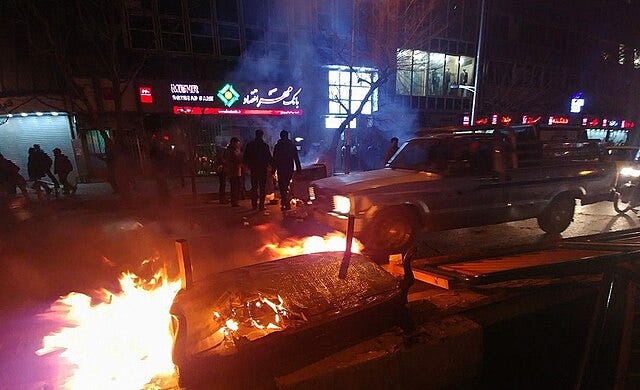
Iran finds itself in a critical and precarious moment. What began as economic discontent—fuelled by inflation, corruption, a collapsing currency, and the burdens of sanctions and subsidy reform—has transformed into a broad anti-regime movement.
Protests erupted in late December 2025 after the rial plunged to record lows, particularly in Tehran’s Grand Bazaar—a historic hub of merchant protests. Almost immediately, demonstrations expanded nationwide, drawing in students, workers, and ordinary citizens fed up with decades of stagnation and repression.
In recent days, protesters have taken to the streets in over 100 cities, challenging the legitimacy of the Islamic Republic itself.
II. State Reaction — Crackdown and Connectivity Blackouts
The Iranian government has responded with force. Security forces have used lethal measures, resulting in dozens of confirmed deaths and hundreds of injuries. Authorities have detained thousands and deployed the Baseej, police and IRGC elements to suppress dissent.
In a dramatic escalation, the state has shut down most internet access, aiming to stifle coordination among protesters and conceal events from the outside world.
III. A Rare Foreign Backing for Protesters
Against this backdrop, former U.S. President Donald Trump has voiced strong support from abroad, warning Tehran against violent repression and suggesting U.S. assistance to the Iranian people if the regime crosses lines.
This is highly atypical: U.S. leaders have historically tread carefully regarding Iranian internal unrest, but the confluence of a domestic crisis and geopolitical shifts appears to have altered the calculus.
IV. The Regime’s Strategic Role in the Middle East
Since 1979, the Islamic Republic has been a central pivot in Middle Eastern conflict geography—often described as a spoiler state. It has sponsored and supported:
Hamas in Gaza,
Hezbollah in Lebanon,
Houthis in Yemen,
Assad’s regime in Syria,
Proxy networks that challenge the Sunni Arab states and Israel.
Iranians fought a brief but intense 12-day war with Israel in late 2025, marking a rare direct confrontation after years of indirect proxy operations.
Tehran also maintained ties with Venezuela’s Nicolás Maduro and supplied Shahed drones to Russia for its war in Ukraine — demonstrating strategic alignment that extended well beyond the region.
V. If the Regime Falls — What Could Follow?
The fall of the Islamic Republic would create seismic geopolitical repercussions.
1) Fragmented Opposition, Fragile Unity
Iran’s political opposition remains weak and fragmented. There is no unified leadership capable of immediately filling the power vacuum. Much depends on whether elements of the Baseej, IRGC, or regular armed forces defect to the protest movement — a decisive turning point that could signal regime collapse.
2) The Shah as Symbol or Reality?
While popular chants echoing support for the exiled Pahlavi family have appeared, a restoration of the monarchy remains unlikely absent active Western orchestration. Even so, the symbolic appeal of the former dynasty — especially if backed by external powers — could catalyse certain factions.
3) Emergence of a “Strongman” Leader
Perhaps more plausible is the rise of a strongman figure from within the security apparatus — someone who can consolidate bits of the fragmented security forces, appeal to nationalist instincts, and present a semblance of stability.
4) Strategic Fallout for Russia and China
For Russia, losing Iran as a strategic partner would be a substantial blow—both reputational and operational. Moscow has relied on Tehran to help counter Western influence and to supply critical military hardware for its campaign in Ukraine. A collapse of the Iranian regime would deprive Russia of a key ally on its southern flank and strain its efforts to sustain influence in the Middle East.
For China, whose long-term energy and Belt and Road interests are deeply intertwined with Iranian infrastructure and geopolitics, the uncertainty surrounding a post-Islamist Iran presents a major strategic dilemma: balancing economic ties with regional stability.
5) Israel and the Gulf States
A post-Islamist Iran could dramatically alter the strategic equations for Israel and the Gulf Arab states — potentially reducing the threat perception that has driven extensive defence spending, external alliances, and covert operations for years.
Yet, a power vacuum could also spawn new conflicts — especially if ethnic minority regions in Iran (Kurds, Baluch, Azeris) assert autonomy or insurgent movements grow.
VI. What’s Next?
At this stage, Iran remains volatile and unpredictable. The protests are real, the discontent wide-ranging, and the regime’s grip under strain — but not yet broken. Whether the crisis culminates in fundamental regime change, gradual transformation, or a bloody suppression will hinge on how events unfold on the streets and within the state’s security apparatus.
One thing is clear: Iran’s future — and with it, regional geopolitics — hangs in the balance.
I don't quite understand: violent repression in Iran is unacceptable, while the same in the USA is OK?