
Unmanaged Chaos
The MAGA Coalition and the Limits of Trumpian Imperialism

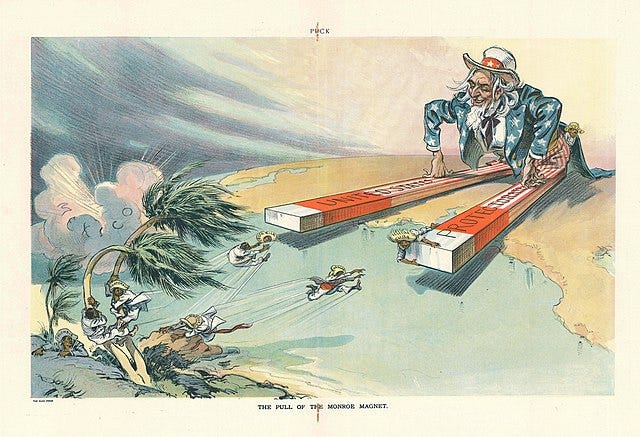
“What may not be ending is Pax Americana itself, but its mutation into a new order — or disorder — we might call Pax Trumpicana.”
John Bruni
Perhaps the most under-examined dimension of Pax Trumpicana is not how America’s rivals respond — but how Trump’s own political base absorbs it.
MAGA is not ideologically uniform, but it has consistently shared one defining feature: deep hostility to U.S. military interventionism. Trump’s 2016 and 2024 victories were built in part on repudiating the neocon consensus — the belief that American power must be exercised globally, continuously, and often violently to preserve order.
What we see emerging now, however, is something different — not liberal interventionism, but transactional imperialism. It does not speak the language of democracy promotion or human rights. It speaks instead of leverage, sovereignty as conditional, and order imposed through pressure rather than persuasion.
This creates a tension inside the MAGA worldview.
On one hand, Trump’s supporters are more tolerant of coercive tactics if they are:
limited in duration
framed as law-and-order operations
and explicitly contrasted with “endless wars”
On the other hand, direct actions — such as regime disruption, territorial pressure, or sustained economic strangulation — risk collapsing the distinction between anti-war realism and neo-imperial behaviour.
The Venezuela operation, the Greenland rhetoric, and the open willingness to pressure allies like Canada all test that boundary.
The critical variable is duration and escalation. MAGA voters may accept shock-and-awe diplomacy. They are far less likely to accept:
long-term occupations
cascading conflicts
or ideological justifications for force
If Pax Trumpicana remains episodic, coercive, and results-driven, the base may adapt — reframing it as strength without entanglement. But if unmanaged chaos becomes managed conflict, Trump risks reopening the very political wound that powered his rise.
In that sense, the greatest constraint on Trumpian imperialism may not be China, Russia, or Europe — but the memory of Iraq embedded within his own coalition.
Pax Trumpicana is not yet a doctrine. It is a posture — improvised, forceful, and deliberately unsettling. Whether it hardens into a sustainable order or collapses into unmanaged chaos depends on three forces: foreign resistance, institutional limits, and domestic tolerance.
History suggests empires rarely fall because of their enemies alone. They fracture when their own narratives can no longer contain their actions.
Trump may yet discover that the line between ending wars and wielding empire is thinner — and more politically dangerous — than it first appears.
An interesting perspective that gives Trump credit for creating an alternative to conventional concepts? I find the notion of Trump developing this concept challenging. History will prove or disprove, but there is rationale in the argument.